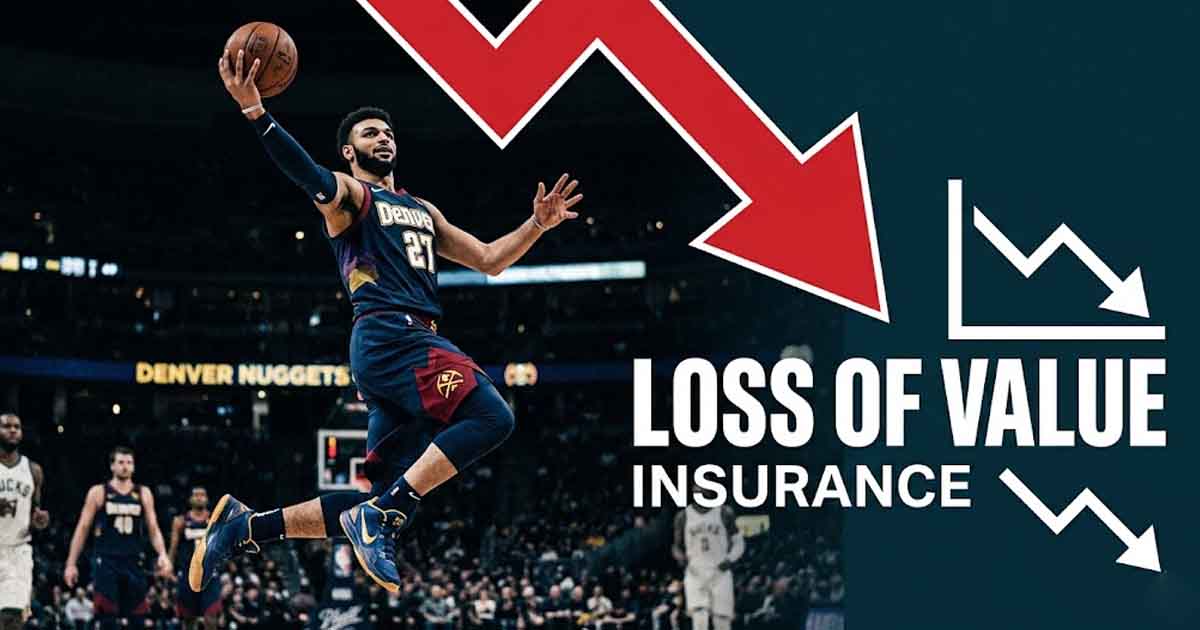
Loss of Value insurance is one of the most powerful and least understood products in the athlete insurance market. While disability and career-ending insurance get more attention, LOV insurance addresses a risk that is arguably more common and more financially damaging for many athletes: the reduction in earning power caused by injury, even when the athlete does return to play. This guide explains exactly how it works, who needs it most, and the real cases that show why it matters.
What Loss of Value Insurance Actually Does
LOV insurance compensates an athlete when an injury causes their contract market value to fall below the projected level at the time the policy was taken out. The key distinction from career-ending insurance is that the athlete does not need to retire — they just need to demonstrate that their earning potential has been materially reduced by a covered injury.
The typical structure works like this:
- The athlete takes out a LOV policy, with an insured value set at their projected future contract worth
- An injury occurs and is treated under the policy
- At the point of the athlete's next contract negotiation, an independent assessment compares actual contract value with the projected insured value
- If actual value is lower than projected value, the policy pays the difference — up to the insured maximum
How Jamal Murray's Knee Injury Demonstrated LOV Risk
Denver Nuggets guard Jamal Murray tore his ACL in April 2021, keeping him out for over a year. Before the injury, Murray was projected as a maximum contract player — a potential $170 million+ deal. His injury — and the uncertainty around his recovery — created exactly the scenario LOV insurance is designed to address: a player whose injury, even if fully recovered from, casts a shadow over their next contract negotiation.
Murray did ultimately recover and won the NBA Championship with Denver in 2023, signing a significant extension. But his path illustrates the risk: had his recovery been less complete, or his subsequent performance less convincing, his next contract could have been dramatically reduced compared to pre-injury projections.
The NFL and the Birth of LOV Insurance
LOV insurance was largely invented for the NFL and NBA context, specifically to protect athletes in the transition from college to professional sport. Consider Saquon Barkley — one of the most gifted running backs of his generation. He was projected as a top-five NFL Draft pick, but if he had suffered a serious injury in his final college season, his draft position and therefore his rookie contract value would have been dramatically affected.
LOV policies taken out before a final college season — and before the NFL Draft — protect against exactly this scenario. The NCAA has facilitated access to these policies, and most agents representing potential first-round picks now ensure LOV coverage is in place before the season begins.
How the LOV Payout Is Calculated
The calculation of a LOV payout involves independent assessment of the athlete's projected value at the time the policy was purchased — typically based on draft projections, agent assessments, and comparable contract data — versus their actual contract. The difference, subject to the policy maximum and any deductible, is the payout. Most LOV policies carry a minimum loss threshold — typically 10% to 20% — before they activate, to prevent claims for minor market fluctuations.
Which Sports Have the Highest LOV Risk?
LOV insurance is most valuable in sports where:
- Contract values are high and performance-dependent
- Injury history has a demonstrable long-term impact on market value
- The transition from college/academy to professional sport involves a significant valuation event (draft, first professional contract)
American football, basketball, and baseball are the highest-demand markets. In European football, LOV insurance is increasingly relevant for players approaching contract renewals or transfer moves — a phase when an injury can critically undermine an athlete's negotiating position.
Cost and Availability of LOV Insurance
LOV insurance is a specialist product and not available through standard insurance brokers. It is typically underwritten by specialist sports insurers through Lloyd's of London or dedicated sports insurance facilities. Premiums vary but typically range from 1% to 4% of the insured value. For a college athlete insuring a projected $10 million contract, annual premiums might run from $100,000 to $400,000 — substantial, but a fraction of the risk being covered.
Key Questions to Ask Before Taking Out LOV Cover
- What is the insurer's definition of a qualifying injury?
- What is the method for establishing projected contract value, and who makes that assessment?
- What is the minimum loss threshold before the policy activates?
- Are pre-existing conditions excluded?
- What is the policy period — is it tied to a specific contract event or ongoing?
Loss of Value insurance will not be the right product for every athlete. But for any player approaching a major contract negotiation or a career-defining draft moment, it is one of the most targeted and efficient forms of financial protection available. The risk it addresses is real, well-documented, and potentially worth millions.


Add a Comment