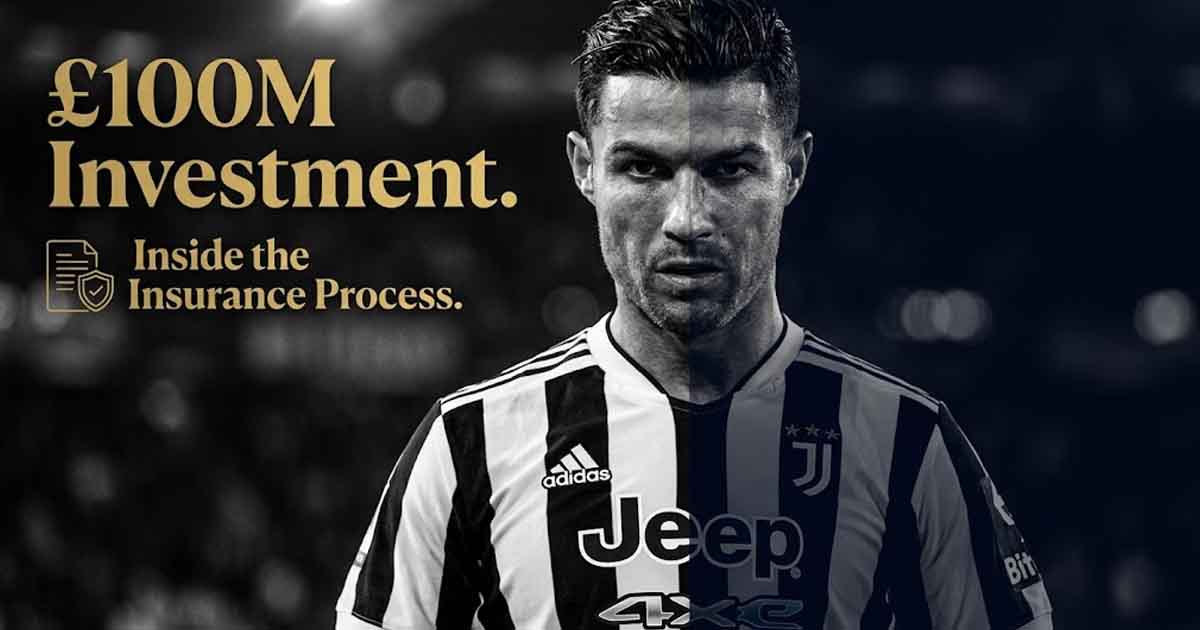
When Cristiano Ronaldo sustained a knee injury during his time at Juventus in the 2020-21 season — one of several physical setbacks during his three seasons at the Turin club — it triggered not just a medical response but a financial one. Ronaldo's transfer to Juventus in 2018 for a reported €100 million fee, combined with wages reported at €31 million per year net, represented one of the most significant single-player financial investments in football history at the time. The insurance programme built around that investment — covering the transfer fee, the wage commitment, and Ronaldo's commercial value to the club — was proportionally enormous. Understanding what that process looked like provides a unique window into how elite athlete insurance actually functions at the highest level.
What Juventus Were Insuring: The Full Financial Picture
Juventus's financial exposure to Ronaldo was not limited to the €100 million transfer fee, impressive as that figure was. The true insurable value of their investment encompassed:
- Transfer fee amortisation: The €100 million fee was amortised over four years — approximately €25 million per year in the club's accounts. This amortisation is a real financial cost that continues regardless of whether the player is fit to play.
- Wages: Reported gross wages of €60+ million per year — one of the highest wage commitments in Italian football history.
- Commercial revenue attributable to Ronaldo: His arrival at Juventus was estimated to have generated over €60 million in shirt sales in the first 24 hours alone. His ongoing presence drove subscription growth for Juventus TV, expanded the club's Asian commercial market, and supported sponsorship values. These commercial revenue streams are directly dependent on his continued availability and performance.
- Champions League revenue impact: Ronaldo was signed specifically to help Juventus win the Champions League — and the prize money and commercial benefits associated with Champions League success are substantial. His injury-affected performances in the knockout rounds (he was absent for critical periods) directly affected the club's Champions League outcomes and the associated financial consequences.
How the Insurance Was Structured: A Layered Programme
Insurance of a player with Ronaldo's profile at Juventus was not a single policy. It was a layered programme, structured across multiple specialist insurers and Lloyd's of London syndicates, with different layers covering different risk scenarios and different financial exposures:
Layer 1: Wage Continuance
The most straightforward layer — covering wages paid during injury periods. This is standard across top-level football clubs, typically covering a percentage of wages (often 80%) for defined injury absence periods. For Juventus, with Ronaldo earning €60+ million per year gross, even short injury periods represented very significant insured losses.
Layer 2: Transfer Fee Protection
Coverage against permanent career-ending injury that would render the transfer fee unrecoverable through either player performance or future sale. This layer is typically capped at the transfer fee value and structured to pay out only on a declared permanent disability — but its existence protects the club's balance sheet against the catastrophic scenario of a player who can never play again.
Layer 3: Commercial Revenue Protection
The most complex layer — covering the loss of commercial revenue attributable to extended absence. This requires specialist underwriting because the relationship between player availability and commercial revenue is not linear and is difficult to quantify precisely. It typically covers specific commercial triggers: if shirt sales fall below a defined threshold during an injury period, or if sponsor payments are adjusted due to reduced player availability, the policy compensates for the difference.
Ronaldo's Personal Insurance: What He Was Protecting
Parallel to Juventus's corporate insurance programme, Ronaldo maintained his own personal insurance coverage — separate from, and not dependent on, whatever the club had in place. His personal programme — managed through specialist advisers and reportedly including the famous leg insurance valued at over €100 million — covered his personal income from all sources: wages, commercial income, image rights, his CR7 brand revenues, and his hotel and commercial ventures.
The interaction between club insurance and personal insurance is a critical aspect of elite player insurance that is rarely discussed publicly. In a complex claim scenario — where a player's injury affects both club income and personal commercial income simultaneously — having both programmes in place, with advisers who understand how they interact, is essential for maximising the total recovery.
What the Juventus Episode Teaches About Insurance Transparency
One of the most instructive aspects of the Ronaldo-Juventus period is how much was publicly known — and how much was not. The transfer fee, the reported wages, and the commercial impact were all subject to significant media analysis. The insurance programme — its structure, its terms, its claims history — was known only to the parties involved.
This opacity is normal in commercial insurance. But it means that the athletes themselves — and the clubs — must actively engage with the details of their own programmes rather than relying on general understanding of what "standard" coverage looks like. For a player at Ronaldo's level, "standard" coverage would have been catastrophically inadequate. The programme that was actually in place — structured specifically around his unique value profile — was the product of specialist expertise and detailed attention to the specific risks involved.
The Lesson Every Club and Athlete Should Take
The Ronaldo-Juventus insurance story is, ultimately, a story about proportionality. The financial commitment was extraordinary. The insurance response needed to be equally extraordinary. Generic, off-the-shelf coverage would not have addressed the specific exposure. Specialist, bespoke, layered coverage — designed around the actual financial profile of the specific player — was the only appropriate response.
The same principle applies at every level of professional sport. Your insurance programme should be as carefully designed around your specific financial profile as Juventus's was around Ronaldo's. The scale is different. The principle is identical.


Add a Comment