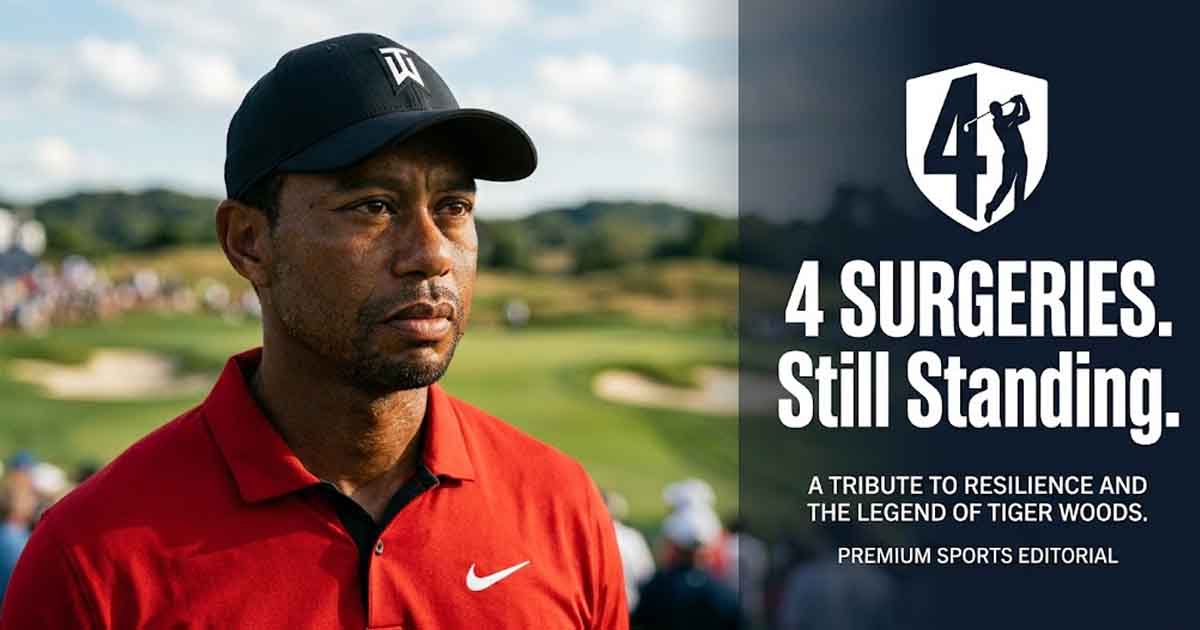
No athlete in modern sport has faced a more complex combination of physical adversity and financial exposure than Tiger Woods. Between 2008 and 2021, Woods underwent four major back surgeries — including a spinal fusion in 2017 that many believed would permanently end his career — and survived a near-fatal single-vehicle car crash in February 2021 that shattered his right leg in multiple places and required hours of emergency surgery. Through all of it, Woods remained one of the most commercially valuable athletes on the planet. That is not an accident. It is the result of one of the most sophisticated athlete insurance and financial protection programmes ever constructed.
Tiger Woods' Injury Timeline and the Insurance Challenge
Woods's physical challenges began long before his back surgeries. His left knee underwent ACL reconstruction in 2008, keeping him out for eight months following the US Open — which he famously won while playing in severe pain. The combination of multiple knee surgeries and the biomechanical compensation they caused is widely understood to have contributed to the back problems that followed.
His four back surgeries — in 2014, 2015, 2016, and 2017 — each presented the insurance question in a different form. The first three were discectomy and microdiscectomy procedures, with uncertain return timelines. The fourth — the spinal fusion in April 2017 — was the most serious. Fusion surgery typically involves a permanent structural change to the spine and carries a statistical probability of never returning to elite athletic performance. For insurance purposes, each procedure created a fresh set of coverage challenges: pre-existing condition complications, policy renewal questions, and the fundamental uncertainty about whether Woods would ever compete again at the level that justified his insured values.
How Woods Structured His Coverage Through His Surgeries
Woods's insurance programme — managed by specialist advisers integrated with his financial management team — was structured in layers that addressed different risk scenarios simultaneously. The coverage included career interruption provisions that activated during the periods he was unable to compete on the PGA Tour. These provisions covered not just playing income but the commercial and endorsement income that remained central to his financial profile even during periods of absence from competition.
His relationship with Nike, which ran from 1996 until Nike exited the equipment business in 2016, included provisions that addressed injury-related inability to participate in commercial activities. His subsequent partnership with TaylorMade and his apparel deal with Sun Day Red — launched by TaylorMade in 2024 — reflect a commercial structure that has been carefully engineered to remain viable even during periods of competitive absence.
The 2021 Car Crash: When Insurance Faced Its Ultimate Test
The February 2021 car accident near Los Angeles was the most serious test of Woods's protection framework. His right leg suffered open fractures to the tibia and fibula, comminuted fractures around the ankle, and significant soft tissue damage requiring immediate surgery and multiple follow-up procedures. Doctors who treated him described the injuries as life-threatening in the immediate aftermath.
For insurance purposes, the crash presented a scenario categorically different from the back surgeries: it was a traumatic external event rather than an overuse injury. Most athlete insurance policies distinguish between these categories, and the specific terms of the coverage — whether the crash fell within policy definitions, what exclusions might apply to vehicle accidents, and how the pre-existing back condition interacted with the new injuries — would have been central to any claims process.
Woods returned to competitive golf at the Masters in April 2022, fifteen months after the accident. He played in subsequent major championships and continued to participate in professional golf on a limited basis through 2024 and 2025. His ability to manage his return entirely on his own terms — without financial pressure to compete before he was ready — is the clearest indicator that his insurance and financial protection programme was functioning as designed.
What Every Athlete Must Learn From Tiger's Experience
The lessons from Woods's career are unusually comprehensive because his experience has covered virtually every category of athlete insurance scenario:
- Long-term overuse injury: The knee and back issues demonstrate the importance of coverage that addresses cumulative physical deterioration, not just acute traumatic injury.
- Repeated procedures on the same body part: Each new surgery created fresh coverage complications. Policies must be reviewed after every significant medical event.
- External traumatic event: The car crash illustrates the importance of policy language that addresses off-sport traumatic events as comprehensively as sporting injuries.
- Commercial income dependency: For athletes whose commercial income rivals or exceeds playing income, coverage must be designed around the total income picture — not just salary or prize money.
- Enabling choice, not forcing decisions: The most tangible evidence of adequate coverage is the ability to make comeback decisions based entirely on physical readiness rather than financial necessity.
Woods is currently 50 years old. His competitive career has been shaped by extraordinary talent, extraordinary adversity, and — crucially — extraordinary financial preparation. The last of these made the first possible for far longer than it would otherwise have been.


Add a Comment