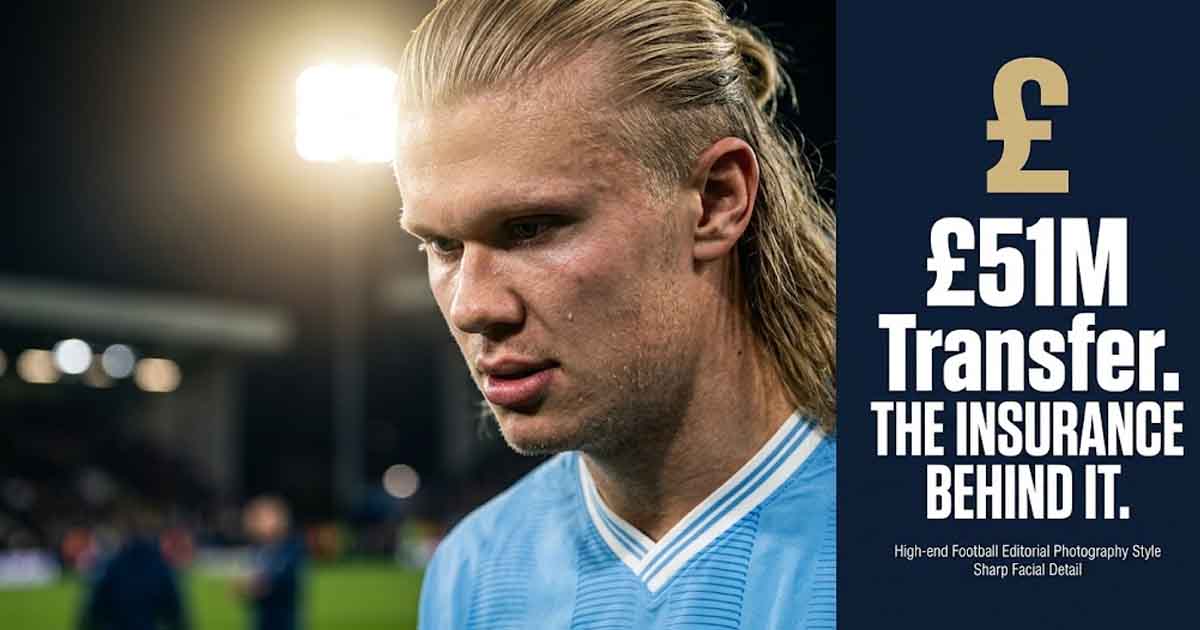
When Erling Haaland sustained a foot injury during Manchester City's 2023-24 season, the immediate sporting concern was whether he would be fit for City's Champions League campaign. But behind the injury bulletins and team news updates, a far more complex financial event was unfolding. Haaland's injury triggered a multi-million pound insurance chain that involved Manchester City's player insurance programme, the Premier League's collective insurance arrangements, and the intricate web of performance-related financial provisions buried in one of football's most commercially significant player contracts. His case is the clearest 2024 illustration of how athlete insurance works — and how much is at stake — at the very top of the modern game.
What Manchester City Were Insuring When They Signed Haaland
When Manchester City signed Haaland from Borussia Dortmund for £51 million in June 2022, the transfer fee was, in financial terms, one of the smaller numbers involved. His reported wages — approximately £375,000 per week, rising with performance — represented a wage commitment of approximately £19.5 million per year. Over a five-year contract, that is a wage exposure of approximately £97.5 million, before bonuses. Add the transfer fee, and City's total financial commitment approached £150 million.
From City's insurance perspective, they were not insuring £51 million. They were insuring a total exposure — transfer amortisation, wages, and commercial value attributable to Haaland's presence in the squad — that ran into hundreds of millions of pounds. Their insurance programme needed to cover the wage continuance during injury, the potential impact on Champions League prize money if Haaland's absence affected results, and the commercial revenue exposure arising from reduced on-pitch availability.
How Haaland's Injury Was Processed Through the Insurance Market
When Haaland's injury was confirmed and his absence for a defined period was established, City's insurance team initiated the claims process under their player insurance programme. For a player of Haaland's value, the claims management process is not a simple form-filling exercise. It involves:
- Independent medical assessment to confirm diagnosis, cause, and expected return timeline
- Calculation of insured losses — wages paid during absence, Champions League progression impact, commercial programme disruption
- Claims notification to the relevant Lloyd's syndicates and specialist sports insurers underwriting the programme
- Ongoing monitoring — insurers typically require regular medical updates for claims involving players of this value
- Quantum assessment — establishing the precise financial loss attributable to the covered injury period
The process for a player at Haaland's level involves the same specialist sports insurance lawyers and claims consultants who handle the most complex commercial insurance claims in the London market. This is not hyperbole: a single player injury claim involving wages, performance bonuses, and Champions League impact can easily exceed £10 million in total insured value.
The Transfer Market Dimension: How Injury Affected the Real Madrid Speculation
Throughout 2024 and into 2025, Haaland was the subject of persistent transfer speculation linking him to Real Madrid. The valuation of that potential transfer — and the insurance implications of a player of his profile moving between clubs — was directly affected by his injury history. Transfer market valuations are not simply about current performance; they reflect risk-adjusted future performance. An injury history that creates uncertainty about availability — even without compromising absolute quality — depresses transfer valuation and increases the cost of insuring the transfer fee against injury and performance risk.
For Real Madrid — who ultimately signed Haaland in the summer of 2025 — the insurance programme around his acquisition required specific underwriting consideration of his foot injury history. Specialist insurers underwriting the loss-of-value and transfer fee protection provisions of the deal would have examined his medical records in detail, sought independent medical assessment, and priced the coverage to reflect the actual risk profile of a player with his specific injury background.
What the Haaland Case Tells Us About the 2026 Insurance Market
Haaland's situation is emblematic of where the elite athlete insurance market has moved in 2026. The key trends his case illustrates:
- Total value exposure has grown exponentially: Insuring a player no longer means insuring just a transfer fee. It means insuring a total commercial ecosystem.
- Injury history is priced with increasing precision: Specialist insurers have more data than ever before about injury risk profiles in specific sports and specific player types.
- Transfer-related insurance is now standard: Major clubs routinely purchase insurance products specifically tied to transfer events — covering the transfer fee, the wage commitment, and in some cases the sell-on value.
- The claims process has become more sophisticated: The gap between clubs with dedicated insurance management capability and those without is growing — and it is measured in millions of pounds of recoveries.
Erling Haaland's foot injury was, for him, a frustrating but manageable interruption to an extraordinary career. For the insurance market, it was a reminder of exactly how much is at stake — and why the systems designed to manage that exposure need to be as professional and sophisticated as the athletes they protect.








Add a Comment