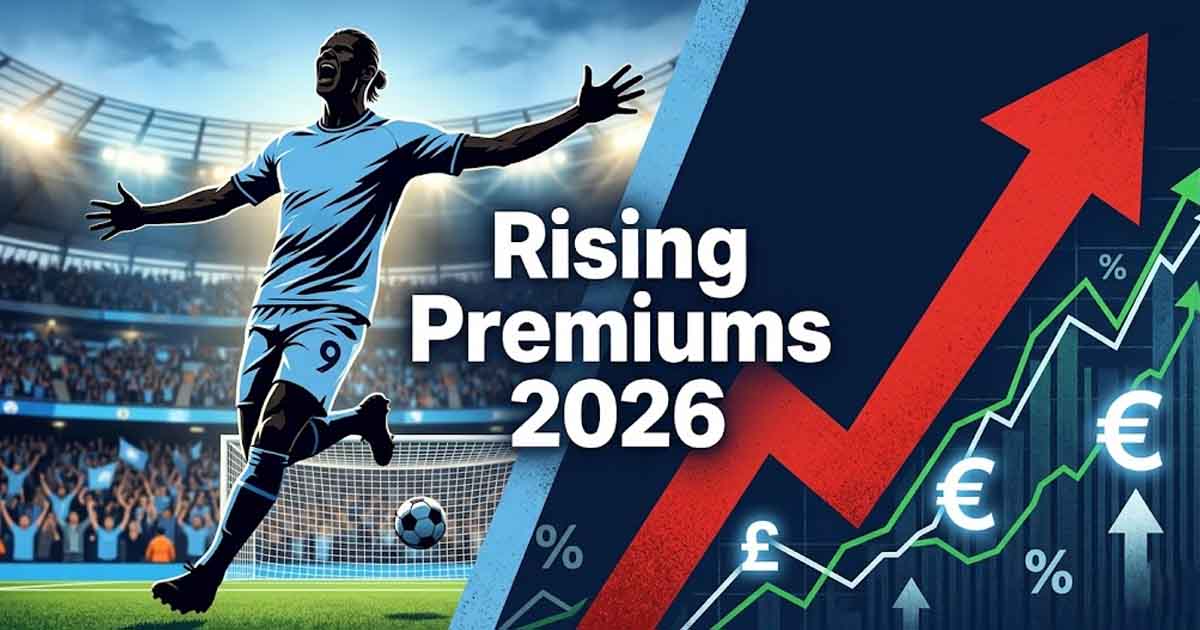
The global athlete insurance market is experiencing a period of significant premium inflation in 2026. A combination of high-profile injury claims, increasing contract values, and the growing sophistication of loss calculations has pushed premiums across elite sport to levels not seen since the early 2000s. For athletes, clubs, and the agents who negotiate their contracts, understanding the dynamics of the current insurance market is essential to making well-informed financial decisions.
The Haaland Effect: How One Athlete Moved the Market
Erling Haaland has become, perhaps unintentionally, one of the most significant figures in the athlete insurance market. Manchester City's investment in the Norwegian striker — a transfer fee reported at £51 million, plus wages understood to exceed £375,000 per week — made him one of the most heavily insured athletes in European football. When Haaland suffered a foot injury in the 2023-24 season that kept him out for several weeks, the claim — covering wages, potential performance bonuses, and impact on Champions League participation — reportedly ran to several million pounds.
For insurers, Haaland's case crystallised something the market had been aware of for years: the compound nature of modern athlete insurance exposure. It is not just salary. It is salary, bonuses, performance targets, Champions League prize money, commercial and image rights obligations, and the reputational impact on the club. When all of these are properly quantified, the insured value of a player like Haaland dwarfs what would have been contemplated a decade ago.
Mbappé's Real Madrid Move and the New Benchmark in Coverage
Kylian Mbappé's arrival at Real Madrid in 2024 set a new benchmark for athlete insurance in European football. His total economic value to the club — wages, potential sell-on value, commercial revenue attributable to his brand, and Champions League earning potential — was assessed by some analysts at over €1 billion across a five-year contract. Insuring an asset of this scale requires a fundamentally different approach to underwriting: bespoke, layered coverage across multiple Lloyd's syndicates, with different layers covering different risk scenarios.
The premium cost for a programme of this scale is substantial. Industry estimates suggest that insuring an asset with the profile of Mbappé — including all commercial and performance-related income streams — could cost between €15 million and €25 million per year in premiums. The precise figures are commercially sensitive, but the scale illustrates how elite athlete insurance has become a significant cost centre for the world's major clubs.
How Rising Claims Are Reshaping the Underwriting Market
The increase in claims across the athlete insurance market is being driven by three structural factors:
Higher Contract Values
As player wages and transfer fees continue to escalate, the insured values that underpin athlete insurance programmes rise proportionally. A Premier League footballer who earned £100,000 per week in 2010 might be earning £300,000 per week for an equivalent role in 2026. The insured salary exposure has tripled, even before accounting for the growth of performance bonuses, image rights, and endorsement income as components of total compensation.
More Comprehensive Loss Calculations
The sophistication with which athlete losses are now calculated has increased significantly. Sports insurance specialists — particularly specialist solicitors who handle complex claims — now routinely include in loss calculations: projected future contract value, endorsement income affected by injury, image rights payments suspended due to performance clauses, and the reputational and commercial impact on the athlete's long-term brand value. These calculations produce far larger claim figures than the straightforward salary replacement models of earlier generations.
Congested Fixtures and Injury Frequency
The expansion of football's Club World Cup, the extension of the Champions League format, and the general increase in fixture congestion at elite level has measurably increased injury frequency among top players. Insurance actuaries have documented this trend, and it is directly reflected in premium pricing. The expectation of higher claim frequency — based on the physical demands of modern football schedules — is already priced into current premiums across the market.
What Rising Premiums Mean for Athletes and Clubs
For clubs, rising insurance premiums are a significant operational cost — one that is increasingly factored into transfer and wage negotiations. For athletes, the impact is more indirect but still real: as insurance costs rise, clubs may become more conservative about player acquisition, more aggressive about fitness and availability clauses in contracts, and more focused on building insurance programme efficiency.
For athletes with excellent injury records and access to strong biometric data — demonstrating good physical condition and professional body management — the current market also presents an opportunity. Insurers competing for the best-risk athletes are willing to offer competitive terms. Proactive data sharing, combined with specialist broker representation, can generate meaningful premium savings even in a rising market.
The Outlook for Athlete Insurance Premiums in 2026 and Beyond
Industry analysts broadly expect the upward trend in athlete insurance premiums to continue through 2026 and into 2027, driven by continued escalation in contract values and the compounding effect of more comprehensive loss calculations. The introduction of AI-driven underwriting — which some expect will begin to stabilise pricing by providing more accurate individual risk assessment — is unlikely to have a broad market impact before 2027 at the earliest.
For athletes and clubs entering the current market, specialist broker advice — tailored to the specific athlete profile and coverage requirements — is more valuable than ever. Cookie-cutter solutions are not adequate for a market of this complexity. The athletes who manage their insurance costs most effectively will be those who engage with the market as proactively as they engage with every other aspect of their professional preparation.


Add a Comment