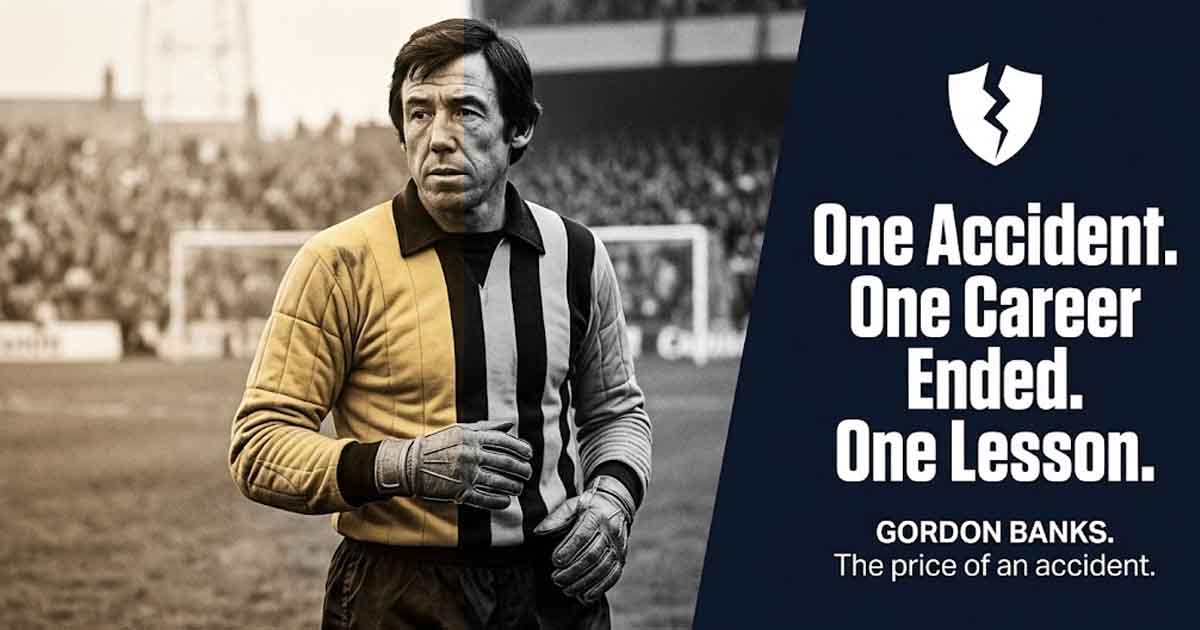
On 22 October 1972, Gordon Banks — England's World Cup-winning goalkeeper and widely regarded as the greatest of his era — was involved in a road traffic accident near his home in Staffordshire. A van ran a red light and struck his car. Banks suffered multiple injuries, the most devastating of which was the permanent loss of sight in his right eye. He was 34 years old, at the peak of his powers, and in the first season of what should have been several more years at the top level. His career was over. The story of Gordon Banks's accident and its aftermath is one of football's most poignant — and one of the most instructive case studies in athlete disability insurance that has ever existed.
What Banks Lost: The Financial Reality of 1972
To understand the full impact of Banks's injury, it is necessary to understand the financial context of professional football in 1972. The maximum wage in English football had only been abolished in 1961 — just eleven years earlier. While top players were earning considerably more than the average worker by 1972, the financial landscape bore no resemblance to the modern Premier League era. Banks was earning a professional footballer's wage at Stoke City, supplemented by international match fees and modest commercial income. There were no multi-million pound image rights deals, no global sponsorship programmes, no television rights bonanzas to share.
Nevertheless, the sudden loss of his career income at 34 — without any equivalent career to move into and with limited post-playing provisions for professional footballers of his generation — created real financial difficulty. Banks subsequently attempted a comeback, remarkably managing to play in the NASL in the United States for Fort Lauderdale Strikers in 1977 and 1978, despite having only one eye — a testament to his extraordinary ability. But his career as an elite-level goalkeeper in English football was definitively ended by the accident.
Why a Car Accident Creates Complex Insurance Issues
Banks's accident illustrates one of the most important and least understood aspects of athlete disability insurance: the difference between injuries sustained during sport and injuries sustained outside it. His career was ended by a road traffic accident — not by a football-related injury. This distinction matters enormously for insurance purposes.
Many athlete insurance policies — particularly in the era before specialist sports insurance became sophisticated — focused primarily on injuries sustained during sporting activity. An off-field accident causing career-ending disability required different coverage: specifically, a permanent total disability policy that covered all causes of career-ending disability, not just those arising from the sport itself.
In the modern insurance market, comprehensive PTD policies for athletes explicitly cover career-ending disability regardless of cause — whether it is a football injury, a car accident, or a medical condition. But this was not universal in Banks's era, and even today, athletes who have not reviewed their policy terms carefully may find that their coverage is narrower than they assumed.
The Broader Legacy: How Banks Inspired Better Athlete Protection
Banks's story — alongside similar cases from his era involving other sportsmen injured in non-sporting accidents — contributed to the gradual evolution of athlete insurance towards more comprehensive, all-cause disability coverage. The Football League and the Professional Footballers' Association developed improved insurance frameworks for players over the following decade, partly in response to the inadequacy of provision revealed by cases like Banks's.
In 2014, Banks was the subject of renewed media attention when he revealed he had been diagnosed with kidney cancer, which he subsequently recovered from. In 2019, he passed away at the age of 81. Throughout his post-playing life, he was celebrated as one of England's greatest athletes — but his financial security in retirement was never on the scale that the financial infrastructure of modern football would have provided for an equivalent player today.
What Every Athlete Must Know: Off-Field Disability is Real Risk
Banks's accident is a reminder that career-ending events do not only happen on the pitch, the court, or the track. Professional athletes face significant off-field risks:
- Road traffic accidents: Professional athletes drive to training, travel to matches, and live normal lives outside sport. The statistical risk of a serious road accident over a ten-year career is not trivial.
- Domestic and recreational accidents: Falls, domestic injuries, and recreational activity accidents are common causes of career-disrupting injury.
- Non-sport health events: Serious illness — cancer, heart disease, neurological conditions — can end careers regardless of physical fitness levels achieved through training.
A comprehensive PTD policy must cover all of these scenarios. When reviewing your disability insurance, the critical question to ask is not just "does this cover football injuries?" but "does this cover any event that permanently prevents me from playing professional football?" Only the second question provides real protection.
Gordon Banks: A Standard for Insurance, Not Just Goalkeeping
Banks made the save from Pelé at the 1970 World Cup that Pelé himself called the greatest save he ever saw. He set standards in goalkeeping that defined the position for generations. His career's end — sudden, accidental, definitive — set a different kind of standard: a demonstration of exactly what comprehensive all-cause disability insurance exists to address. The athletes who carry that coverage today owe a debt, in part, to the examples set by those like Banks who did not.


Add a Comment