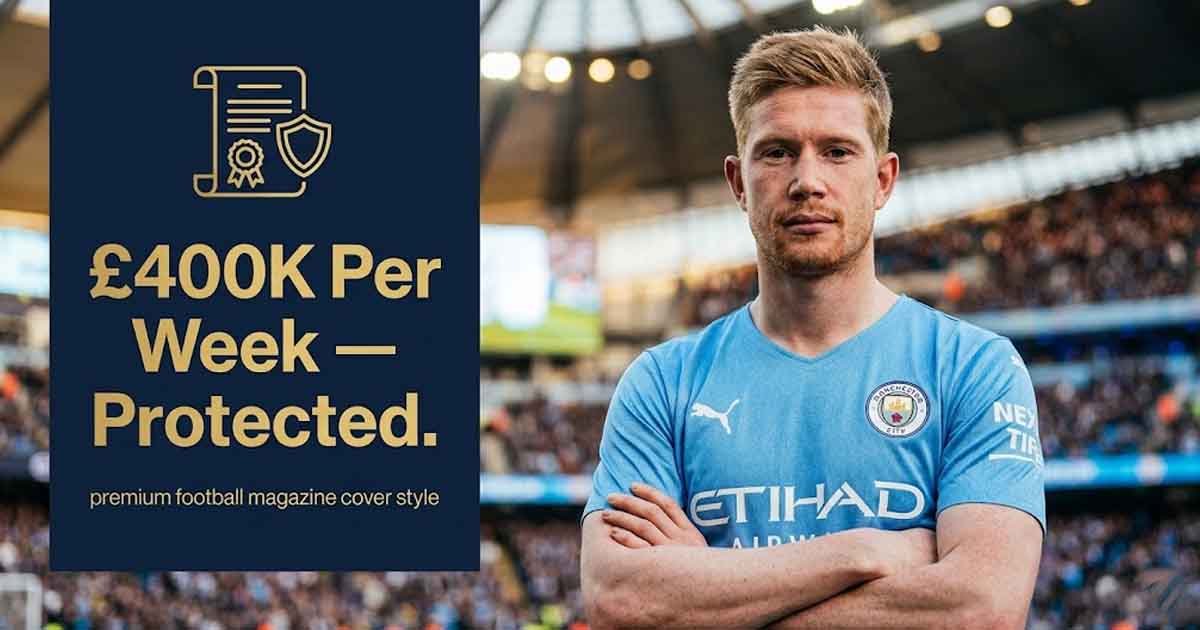
In the summer of 2021, Kevin De Bruyne signed a contract extension with Manchester City that made him the club's highest-paid player — reportedly earning £400,000 per week. What made the negotiation unusual was not the fee itself but the process: De Bruyne, famously, negotiated the deal himself, without a traditional agent, using data analytics to justify his market value in detail. His approach attracted global attention and was widely praised as a new model of athlete contract negotiation. But the aspect of his contract that received almost no public attention — the salary protection and contract guarantee provisions that determine what happens when injury strikes — is arguably more important for the long-term financial wellbeing of any professional footballer.
De Bruyne's Injury History and Why Salary Protection Matters
De Bruyne has suffered multiple significant injuries throughout his career. In the 2020-21 season — the year of his contract extension — he sustained a facial fracture during the Champions League final against Chelsea, having already missed significant periods of the season with knee and hamstring issues. In 2021-22, a hamstring injury kept him out for two months during a critical part of the season. Each injury raised the same underlying financial question: how much of the reported £400,000 weekly wage was actually guaranteed during injury periods, and how was the substantial bonus structure — tied to appearances, goals, assists, and team achievements — protected?
Standard Premier League contracts guarantee the base salary during injury sustained during sanctioned training and competition. But in De Bruyne's case — where the performance-related elements of his compensation potentially represent a significant percentage of his total earnings — the non-guaranteed elements create an exposure that his personal insurance programme must address.
What "Guaranteed" Actually Means in a Top Football Contract
The word "guaranteed" in a football contract is more nuanced than it appears. A typical top-level Premier League contract guarantees the base salary for the contract duration, subject to the player not being dismissed for gross misconduct and not breaching the contract's terms — including prohibited activities clauses. However:
- Appearance bonuses are only payable when the player actually appears — injury removes them.
- Goal and assist bonuses require performance — injury prevents performance.
- Loyalty bonuses may include fitness and availability conditions that injury can affect.
- Release clauses may be triggered if the player fails to meet availability thresholds over an extended period.
For De Bruyne, whose creative output and on-pitch presence are central to Manchester City's tactical system, an extended injury means not just the loss of bonus elements but a potential shift in the club's assessment of his value at contract renewal. The financial protection required is therefore not just about the current contract — it is about protecting the negotiating position for the next one.
How De Bruyne's Self-Negotiation Model Applies to Insurance
The data-driven approach De Bruyne used to negotiate his contract — quantifying his contribution to Manchester City's commercial and sporting success in precise terms — is directly applicable to insurance planning. The same analytical framework that justified his wages to Manchester City can be used to calculate exactly what level of insurance coverage his income profile requires.
An athlete who knows precisely what their income consists of — base salary, appearance fees, goal bonuses, image rights, endorsement deals — and can model the financial impact of different injury scenarios is able to commission exactly the right insurance coverage. The "I have a general policy from the club" approach, common even at elite level, is the antithesis of the De Bruyne model.
The Contract Renegotiation Risk: What Happened When De Bruyne Left City
In the summer of 2025, De Bruyne left Manchester City after his contract expired, joining Napoli in Serie A. At 34 years old, with a significant injury history, his negotiating position was materially different from the 2021 extension. The terms he was able to secure — while still reflecting his outstanding ability — naturally included more performance-related elements and shorter guaranteed periods than a younger, healthier player would attract.
This trajectory — common to most athletes as they progress through their careers — illustrates why loss of value insurance, taken out during peak earning years, is so important. The insurance that protects against the career-value erosion caused by injury is most valuable precisely when the athlete feels least vulnerable. De Bruyne at 27, coming off his best season, was the optimal moment to insure his market value. At 34, the moment has passed — the value erosion has already occurred.
Key Takeaways on Salary and Contract Protection
- Know every component of your contract income — base, bonuses, image rights — and ensure each is covered
- Club insurance protects the club's interest; your personal policy protects yours
- The best time to insure your market value is at your peak — not after an injury has already reduced it
- Every contract renewal is a loss-of-value insurance trigger point — review coverage every time you sign
- If you are good enough to negotiate your own contract, you are good enough to understand your own insurance
De Bruyne's self-negotiation was celebrated as a triumph of athlete intelligence. The same intelligence, applied to insurance, would have been equally powerful — and equally worth celebrating.






Add a Comment