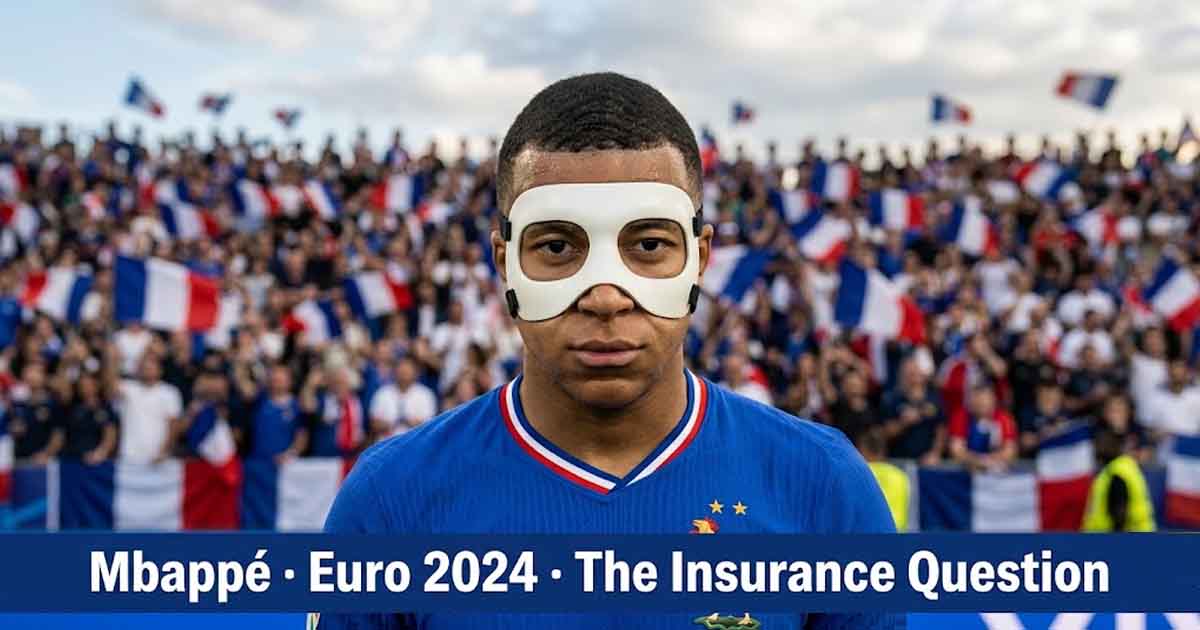
In the 53rd minute of France's opening match at Euro 2024 against Austria, Kylian Mbappé received an accidental elbow to the face from Austrian defender Kevin Danso that fractured his nose in two places and caused significant bleeding. He was forced off the pitch and subsequently required surgery. He returned to the tournament wearing a protective mask — a sight that became one of the iconic images of the competition. But behind the sporting drama, Mbappé's injury raised a set of questions that every professional footballer and their advisers should understand: when an injury happens on international duty, who is responsible? Whose insurance covers it? And what does the claims process actually look like?
International Duty Insurance: The Grey Zone Nobody Talks About
When Mbappé was injured playing for France at Euro 2024, he was not under the authority of his club — at the time, Paris Saint-Germain (he transferred to Real Madrid on 1 July 2024). He was under UEFA and the French Football Federation (FFF). The injury happened while he was on international duty, which creates a specific and often misunderstood insurance situation.
Club insurance policies typically cover injuries sustained in club training and competition. When a player reports for international duty, club coverage is technically suspended — or at minimum complicated by jurisdictional questions — and responsibility transfers to the national federation and UEFA. However, the terms under which this transfer occurs, and what happens to the player's personal income protection during this period, is frequently poorly documented in player contracts and insurance policies.
Mbappé's case was straightforward in one sense: the injury was clearly sustained during a sanctioned UEFA competition, meaning both UEFA's mandatory insurance programme and the FFF's player coverage were directly applicable. But for less clear-cut scenarios — training injuries during international camps, pre-tournament friendly matches, or injuries sustained in transit — the coverage picture is significantly murkier.
What UEFA's Insurance Programme Actually Covers
UEFA operates a mandatory insurance programme for all players participating in its competitions. For Euro 2024, this programme provided coverage for injuries sustained during matches and official training sessions held within the competition window. The coverage included medical treatment costs and a disability benefit in the event of career-ending injury.
However, UEFA's programme was never designed to replace a player's full income. The disability benefit is based on a fixed formula related to the player's age and a standard valuation model — not on the actual commercial value of the player. For a player with Mbappé's profile — whose total annual income including salary, image rights, and endorsements has been reported at over €100 million — the UEFA programme provides a fraction of the actual financial exposure.
This is why personal insurance, structured to cover international duty as explicitly as club competition, is essential for any professional athlete competing in international tournaments.
Real Madrid's Perspective: The Club's Interest in International Injury
From the moment Mbappé signed for Real Madrid in June 2024, the club had a direct financial interest in his physical condition. His transfer — reported as a free transfer but with a signing bonus and wages understood to represent an annual commitment of over €150 million in total player cost — is one of the most significant single-player financial investments in football history.
Real Madrid's insurance programme — which covers player wages and the club's commercial exposure during player absence — would have been among the first calls made after Mbappé's injury was confirmed. Major clubs have dedicated insurance managers whose sole responsibility is managing the club's player insurance programme. The interaction between club insurance, UEFA coverage, FFF coverage, and Mbappé's personal insurance would have been the subject of immediate and detailed analysis.
The Protective Mask and the Commercial Consideration
Mbappé's choice to return to Euro 2024 wearing a protective mask — despite the medical risk of playing with a recently fractured nose — was widely discussed as a sporting decision. It also had insurance implications. Returning to play before full medical clearance, in a way that carries an elevated risk of further injury or aggravation, is a factor that insurers consider carefully when evaluating subsequent claims. The decision to return was ultimately Mbappé's — and France's medical staff approved it — but it illustrates the intersection of sporting ambition, medical risk management, and insurance exposure that arises whenever a player returns early from injury.
What Athletes Playing on International Duty Must Check
- Confirm your personal policy covers international duty explicitly — do not assume it does.
- Understand what your national federation's insurance provides — request the programme details before every international window.
- Know the difference between UEFA/FIFA insurance and your personal coverage — the governing body programmes are a floor, not a ceiling.
- Check the claims notification process for international injuries — the protocol may differ from club injury claims.
- Ensure commercial income is covered during international injury periods — endorsement and image rights income does not pause when you are injured on national duty.
Mbappé's broken nose became a story about sporting heroism. Behind the mask, it was also a masterclass in the complexity of modern athlete insurance — and a reminder that the systems designed to protect elite athletes are only as effective as the attention paid to them in advance.






Add a Comment